# Why Most AI Automation Projects Fail Before They Even Start
AI automation is everywhere.
Businesses are adding AI assistants, chatbots, workflow tools, and AI agents to their operations faster than ever.
But there is a problem.
Adding AI to a broken workflow does not automatically create a better workflow.
In many cases, it simply creates a faster version of the same mess.
The Real Problem Is Usually Not AI
A company may have dozens of tools:
CRM
Email
Google Sheets
Slack
Accounting software
Forms
Databases
Internal applications
But if these systems don't communicate properly, employees still have to move information manually between them.
This is one reason businesses can have modern AI tools while still losing hours to repetitive work.
AI Needs a Workflow to Work With
Imagine a company receives a new customer inquiry.
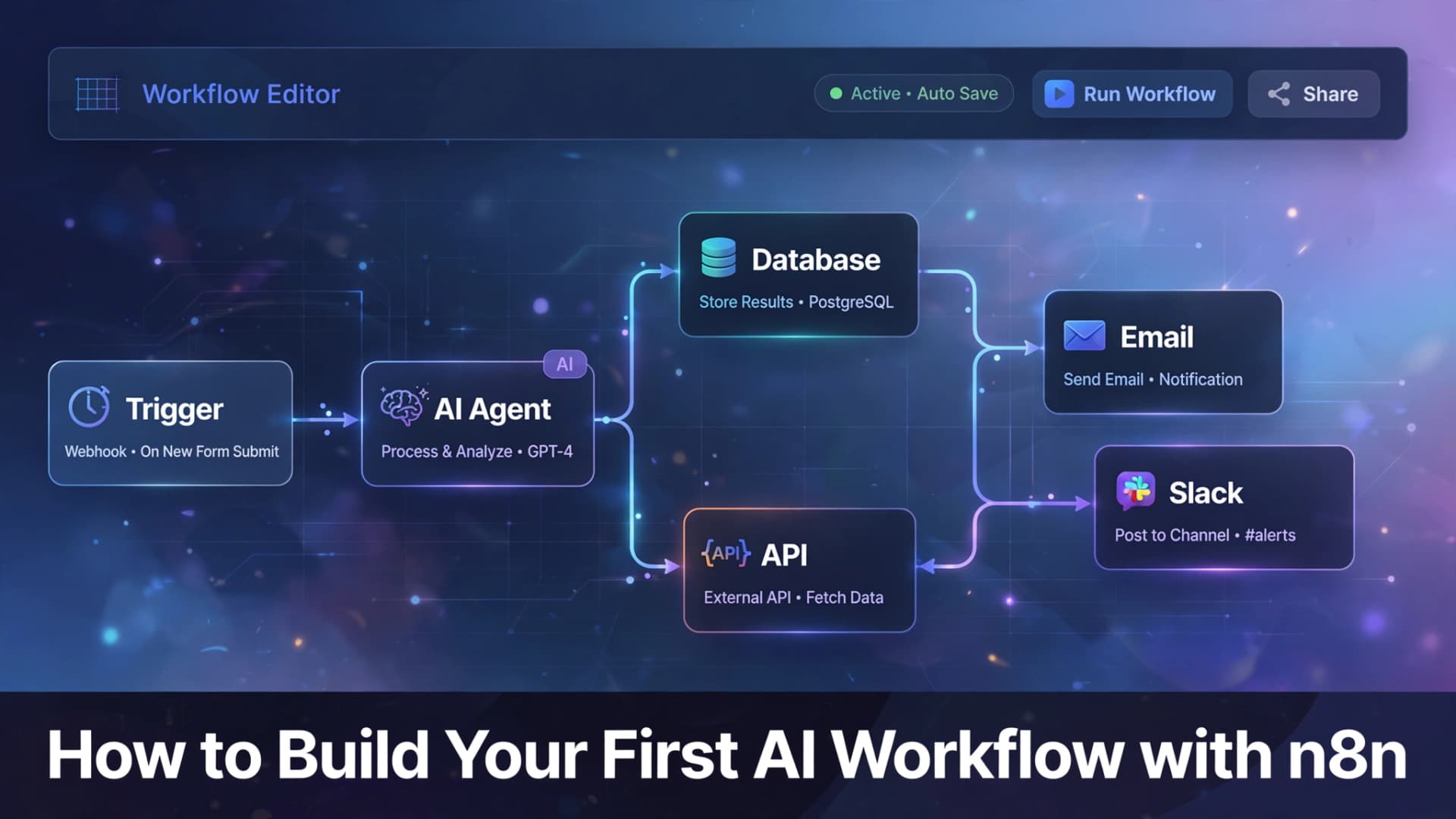
A properly designed automation could:
Capture the inquiry
Understand the customer's request
Enrich the lead
Check the CRM
Assign the lead
Send a personalized response
Notify the sales team
Schedule follow-up tasks
Record everything automatically
The AI is only one part of that system.
The real value comes from connecting the entire workflow.
Why Businesses Get It Wrong
A common mistake is starting with a tool.
For example:
"Let's add an AI agent."
A better question is:
"Which business process should we improve?"
The difference is important.
Technology should serve the process—not the other way around.
Integration Is Becoming More Important
Modern businesses increasingly rely on multiple software systems.
That makes APIs, databases, webhooks, automation platforms, and reliable data flows just as important as the AI model itself.
Recent enterprise AI adoption shows this shift clearly.
AI is increasingly being used across finance, procurement, HR, customer service, and other business operations rather than only for isolated experiments. :contentReference[oaicite:1]{index=1}
Automation Needs Guardrails
A good automation system should also know when not to act.
For sensitive operations, businesses may need:
Human approval
Permission controls
Validation
Error handling
Audit logs
Monitoring
Fallback processes
This becomes especially important when AI agents can interact with real business systems.
The Better Approach
Instead of asking:
"Which AI tool should we use?"
Businesses should start with:
"Where are we losing time, money, or accuracy?"
Then:
Map the process → identify bottlenecks → connect the systems → add AI where it provides real value → test → monitor → optimize.
This approach produces automation that solves a business problem instead of simply adding another piece of technology.
What Good AI Automation Looks Like
The best automation is often invisible.
Employees don't need to think about which API is running or which AI model is processing a request.
They simply see that:
Leads are processed automatically
Documents are handled faster
Data stays synchronized
Customers receive timely responses
Repetitive work disappears
Teams spend more time on valuable tasks
That's the real goal of automation.
Final Thoughts
AI is becoming more capable every month.
But businesses don't win simply by using the newest model.
They win by turning AI into reliable systems that solve real operational problems.
The future of AI automation isn't about adding more tools.
It's about connecting the right tools, workflows, data, and AI into one system that actually works.