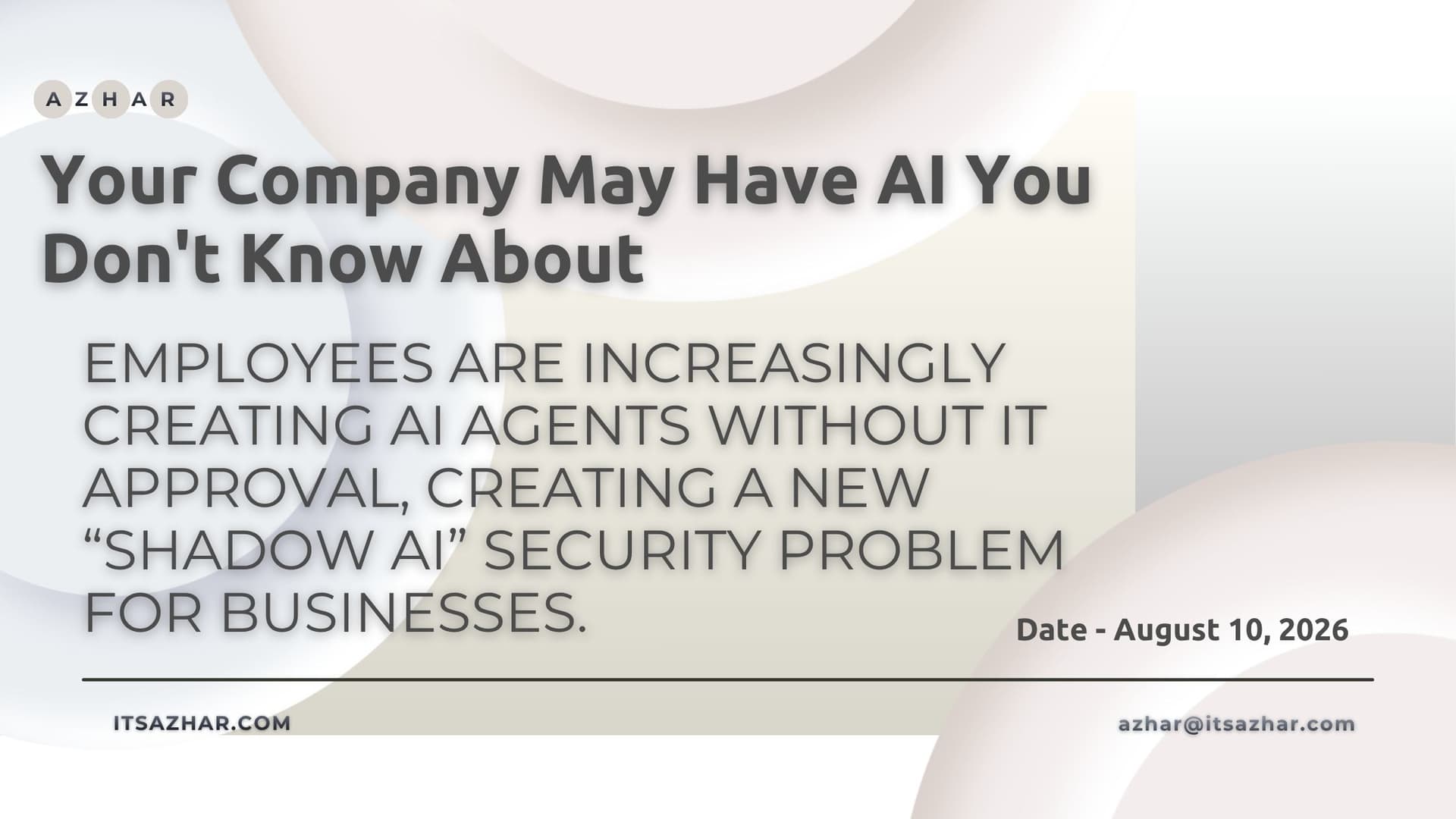
# Employees Are Secretly Deploying AI Agents Inside Companies
AI adoption inside businesses is changing faster than many IT teams can keep up with.
Employees are no longer just using ChatGPT or other AI tools to write emails and summarize documents.
They are increasingly creating AI agents that can perform tasks automatically.
The problem?
Some of these agents may be running inside company systems without the IT department even knowing about them.
What Is Shadow AI?
“Shadow AI” describes AI tools or agents that employees use without going through their organization's normal IT or security processes.
According to a recent warning from Okta, employees can create and activate AI agents with simple prompts, sometimes without informing their IT teams. :contentReference[oaicite:1]{index=1}
Unlike a normal chatbot, an AI agent may continue working automatically and interact with other business systems.
That makes the risk much bigger.
Why Should Businesses Care?
Imagine an employee creates an AI agent to automatically process customer information.
The agent might need access to:
Company documents
CRM systems
Email
Internal databases
APIs
Customer information
If nobody knows the agent exists, nobody may be checking exactly what it can access or what it is doing.
That's where a useful automation can become a security problem.
AI Agents Can Work Without Constant Human Attention
This is what makes the issue different from traditional shadow IT.
A normal unauthorized application might simply store or display information.
An AI agent can potentially make decisions and take actions on its own.
It could process information, call APIs, update records, or trigger other automated workflows.
The more permissions it receives, the more important monitoring becomes.
The Biggest Lesson: Visibility Matters
Businesses don't necessarily need to stop employees from using AI.
They need to know which AI systems exist, what they can access, and what they are doing.
A good AI governance system should include:
Agent inventory
Permission controls
Access monitoring
Activity logs
Data restrictions
Human approval for sensitive actions
The principle is simple:
If an AI agent has access to your business, your business should know about it.
This Could Become a Major Enterprise Problem
AI agents are becoming easier to create.
That means the number of agents inside organizations could grow rapidly—even when companies don't officially deploy them.
For IT and security teams, this creates a new challenge.
They are no longer only managing employees and software.
They may soon need to manage hundreds or thousands of autonomous digital workers.
What Businesses Should Do Now
Companies adopting AI automation should create clear rules before the problem grows.
Employees should know which AI tools they can use, what data they can provide, and when approval is required.
At the same time, organizations should provide approved AI tools so employees don't feel forced to build unofficial solutions themselves.
The goal isn't to eliminate experimentation.
It's to make experimentation visible, controlled, and secure.
Final Thoughts
AI agents could become one of the most useful technologies for business automation.
But there's a catch.
The easier AI agents become to create, the harder they may become to track.
The next big enterprise security problem may not be an unknown hacker.
It could be an AI agent your own company forgot it had.
#AI-News
#AI-Agents
#Shadow-AI
#Cybersecurity
#AI-Automation
#Enterprise-AI
#AI-Governance
#Technology
A
Written by
Azhar
AI automation specialist building systems for businesses worldwide.